
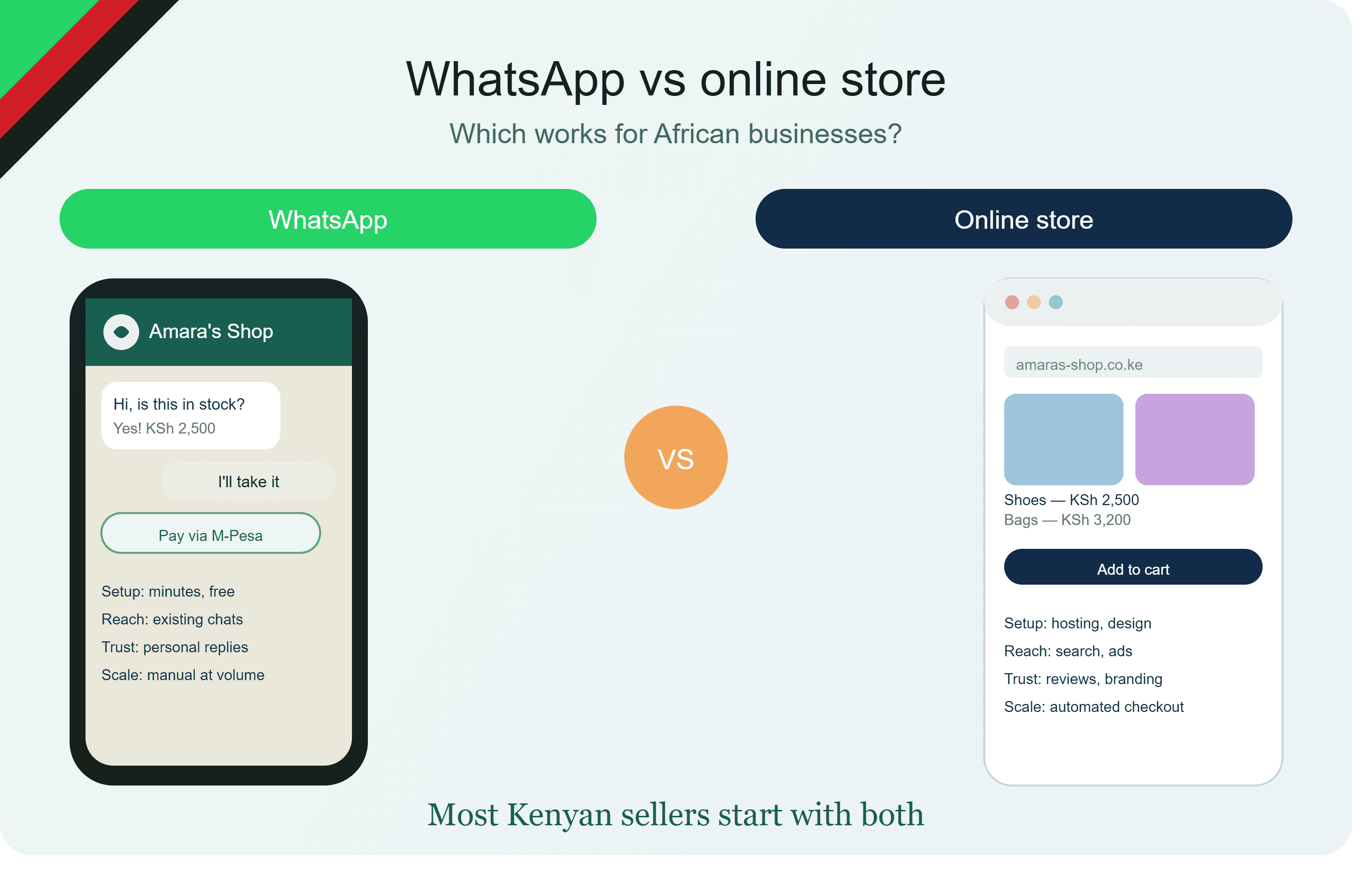
WhatsApp vs Traditional Online Store: Which Model Works for African Businesses?
For many African businesses, the question is no longer simply “Should I have a website or use WhatsApp?”
The more practical question is:
“How can my website and WhatsApp work together to make it easier for customers to buy from me?”
A traditional online store is useful for displaying products, providing information, accepting orders and building a digital presence.
WhatsApp adds something different: conversation.
A customer can see a product on your website, click a WhatsApp button, ask a question, confirm availability, choose a variation, place an order, make a payment and receive updates without having to move between several platforms.
This creates a more connected buying journey:
Discover → Click WhatsApp → Ask → Choose → Order → Pay → Receive Updates → Buy Again
For many African businesses, especially small and growing businesses, this combination can be more practical than treating a website and WhatsApp as competing options.
WhatsApp vs an Online Store: What Is the Difference?
A traditional online store is primarily designed around self-service shopping.
Customers browse products, check prices, select options, add items to a cart, enter their details and complete checkout.
WhatsApp is designed around conversation.
Customers can ask:
- Is this product available?
- Do you have another colour?
- Can you deliver to Kitengela?
- How much is delivery?
- Do you have size 42?
- Can I pay through M-Pesa?
- Can you send me more photos?
- When will my order arrive?
These questions are common in African commerce.
The customer may not want to complete a long checkout process before speaking to someone.
That is where the two models can work together.
The Stronger Model: Website + WhatsApp
Instead of asking customers to choose between your website and WhatsApp, connect the two.
Your website becomes the discovery and information platform.
WhatsApp becomes the conversation and transaction platform.
For example, imagine a customer searching Google for a smartphone.
They find your website and open the product page.
They see:
Samsung Galaxy A56 – KSh 45,000
Instead of only displaying an “Add to Cart” button, the page can also provide:
Chat on WhatsApp
The customer clicks WhatsApp and asks:
“Is this phone available in black?”
Your business responds.
The customer then asks:
“Can you deliver to Nairobi?”
You provide the delivery information.
They confirm the order.
You send payment instructions.
They pay through M-Pesa.
The order is recorded.
Later, the customer receives an update about delivery.
The website brought the customer in.
WhatsApp helped move the customer through the buying process.
Why This Model Makes Sense for African Businesses
African businesses operate in markets where customers often want to speak to a real person before buying.
This is particularly common for products where there are questions about:
- Size
- Colour
- Availability
- Delivery
- Product specifications
- Installation
- Warranty
- Payment
- Location
- Customisation
- Pricing
- Stock
A customer buying furniture may want to confirm measurements.
Someone buying electronics may want to know whether a product comes with a warranty.
A customer buying clothes may want to confirm sizing.
Someone ordering food may need to change an item in their order.
A real estate customer may want to ask about payment plans or viewing arrangements.
These conversations can become part of the sales process.
The Customer Journey Should Feel Connected
One of the biggest problems with many online shopping experiences is that different parts of the customer journey are separated.
A customer may:
- Discover a product on Google.
- Visit a website.
- Find the product.
- Open another payment page.
- Contact the business on WhatsApp.
- Send a screenshot of the payment.
- Wait for someone to confirm the order.
- Contact the business again to ask about delivery.
There is a lot of movement.
A connected website + WhatsApp setup can reduce this friction.
The journey can look like:
Website
↓
Product
↓
WhatsApp conversation
↓
Customer questions
↓
Order
↓
M-Pesa/payment
↓
Payment confirmation
↓
Fulfilment
↓
Delivery update
↓
Follow-up
The important point is not that WhatsApp replaces the website.
It is that WhatsApp becomes part of the commerce infrastructure.
What the Website Should Do
Your website still has an important job.
It can help your business:
1. Get discovered
Customers can find your business through Google, social media, referrals and other channels.
2. Showcase products
A website gives you space to display:
- Product photos
- Prices
- Descriptions
- Specifications
- Product variations
- Frequently asked questions
- Delivery information
3. Build credibility
A professional website can provide information about your business, location, contacts, policies and services.
4. Capture search traffic
People searching for specific products or services can discover your business through search engines.
5. Give customers information before they contact you
A good product page can answer many basic questions before the customer starts a conversation.
But not every question can be answered by a product page.
That is where WhatsApp comes in.
What WhatsApp Should Do
WhatsApp can handle the part of the journey where customers want interaction.
It can help with:
- Product enquiries
- Recommendations
- Customer questions
- Order creation
- Payment instructions
- Payment confirmation
- Delivery communication
- Customer support
- Follow-ups
- Repeat purchases
Instead of forcing every customer into the same checkout process, you can allow them to have a conversation when they need one.
Example: A Kenyan Fashion Business
Consider a clothing business selling dresses online.
The customer sees an Instagram post and visits the company's website.
She finds a dress she likes.
The product page shows:
Floral Dress – KSh 2,500
Available sizes:
- Small
- Medium
- Large
- XL
She clicks:
Order on WhatsApp
WhatsApp opens with the product information.
She asks:
“Do you have size XL?”
The business confirms availability.
She then asks:
“How much is delivery to Kitengela?”
The business provides the delivery fee.
She confirms the order.
The business records:
Order #1048
The customer receives payment instructions.
After payment, the business confirms the order and prepares it for delivery.
Later:
“Hello Jane, your order #1048 has been dispatched. We expect delivery today.”
The customer has not just had a conversation.
The conversation has become part of the order journey.
Example: Electronics Business
An electronics shop can use the same model.
A customer searches for a laptop and lands on the business website.
The product page provides the main specifications.
The customer then clicks WhatsApp and asks:
“Does this laptop come with a warranty?”
The business responds.
The customer asks:
“Can you deliver to Westlands?”
The business confirms.
The customer places the order through WhatsApp.
Payment is made.
The order is recorded.
Delivery information is shared.
The customer receives the laptop.
A few months later, the business can follow up with relevant accessories or related products where appropriate.
This is more than simply using WhatsApp for customer support.
WhatsApp is participating in the commerce process.
What About Customers Who Prefer Traditional Checkout?
They should still have that option.
This is one reason you should not think of WhatsApp as a replacement for your website.
Some customers prefer to:
- Browse independently
- Compare products
- Add items to a cart
- Checkout without speaking to anyone
- Pay immediately
Give them that option.
Other customers may want to talk to someone first.
Give them WhatsApp.
The goal is to support different customer behaviours rather than force everybody into one buying method.
Website + WhatsApp Can Support Different Types of Buyers
A business may have several types of customers.
The Fast Buyer
They already know what they want.
They visit the website, add the product to the cart and pay.
The Question-Asker
They need more information before buying.
They click WhatsApp.
The Price Shopper
They want to confirm price, delivery charges or available options.
They start a conversation.
The Repeat Customer
They already know the business.
They may simply send:
“I need the same shoes I bought last month.”
WhatsApp can make this interaction much easier.
WhatsApp Can Reduce Abandoned Conversations
There is another important opportunity.
Businesses often receive enquiries but fail to follow up.
For example:
Customer: “How much is this?”
Business: “KSh 3,500.”
Customer: “Okay.”
Silence.
The business may never hear from the customer again.
A structured WhatsApp commerce system can help the business keep track of enquiries, orders and customers.
Depending on the setup, businesses can create follow-up workflows such as:
“Hi Mary, just checking if you still need the black handbag you asked about yesterday. We still have it available.”
This does not mean sending customers endless messages.
The purpose is to make sure genuine enquiries do not disappear simply because the business was busy.
WhatsApp + M-Pesa
For African businesses, payment is another important part of the customer journey.
In Kenya, M-Pesa is widely used for everyday payments.
That makes it important for an online selling system to connect the sales conversation with the payment process.
A simple journey could be:
Customer selects product
↓
Customer chats on WhatsApp
↓
Business confirms order
↓
Customer receives M-Pesa payment instructions
↓
Payment is made
↓
Payment is confirmed
↓
Order moves to fulfilment
↓
Customer receives delivery updates
The key is to avoid treating payment as something completely separate from the order.
WhatsApp Is Not Just a Marketing Channel
Many businesses use WhatsApp mainly to broadcast promotions.
For example:
“NEW STOCK AVAILABLE! 🔥🔥🔥”
That can be useful.
But WhatsApp can do much more.
It can support the complete customer relationship:
Marketing
→ Customer discovery
Sales
→ Product conversation
Ordering
→ Order creation
Payment
→ Payment instructions and confirmation
Fulfilment
→ Delivery communication
Customer service
→ Questions and support
Retention
→ Follow-up and repeat purchases
This is where WhatsApp becomes much more valuable to an online business.
How an Integrated WhatsApp Store Can Work
A business using a WhatsApp commerce platform can bring several pieces together.
For example:
Product Catalogue
Customers can see products, prices, images and available options.
Product Variations
Businesses can manage options such as:
- Size
- Colour
- Storage
- Model
- Package
- Quantity
Orders
Customer conversations can lead to structured orders rather than leaving everything inside scattered chats.
Payments
Businesses can provide payment options such as M-Pesa and other supported methods.
Stock
Product availability can be managed alongside orders.
Customer Records
The business can keep track of customers and previous interactions.
Automations
Routine communication can be automated.
For example:
- Welcome messages
- Order confirmations
- Payment confirmations
- Delivery notifications
- Follow-ups
- Re-order reminders
- Back-in-stock notifications
The result is a system where WhatsApp is not simply sitting beside the online store.
It is connected to the commerce process.
Website + WhatsApp for Different African Businesses
This model can work across many sectors.
Fashion Businesses
Use the website to display collections and WhatsApp to help customers with:
- Sizes
- Colours
- Styling questions
- Availability
- Delivery
Electronics Shops
Use the website for detailed specifications and WhatsApp for:
- Product comparisons
- Warranty questions
- Availability
- Delivery
- Accessories
Supermarkets
Use the website or catalogue to display products and WhatsApp for:
- Shopping lists
- Bulk orders
- Delivery questions
- Repeat orders
Furniture Businesses
Use the website to showcase products and WhatsApp for:
- Measurements
- Colours
- Customisation
- Delivery
- Installation
Restaurants
Customers can discover the menu online and move to WhatsApp to:
- Ask about meals
- Place orders
- Request delivery
- Confirm payment
- Receive updates
Real Estate
A website can showcase properties while WhatsApp handles:
- Property enquiries
- Viewing requests
- Location questions
- Follow-ups
- Lead qualification
When a Traditional Online Store Makes More Sense
There are situations where a conventional ecommerce checkout can be particularly useful.
For example, if your business has:
- Hundreds or thousands of products
- Standardised pricing
- Simple product variations
- High transaction volumes
- Customers who prefer self-service checkout
- Complex cart requirements
- Customers from multiple countries
A traditional ecommerce system can provide an efficient self-service experience.
That does not mean WhatsApp has no role.
WhatsApp can still handle customer support, enquiries, follow-ups and selected orders.
When WhatsApp Becomes Especially Useful
WhatsApp can be particularly useful when your customers frequently ask questions before purchasing.
This can happen when:
- Products require explanation
- Prices vary
- Stock changes frequently
- Delivery needs to be confirmed
- Customers want recommendations
- Products have many variations
- Orders are customised
- Customers prefer speaking to a person
In these situations, conversation becomes part of the sale.
The Real Choice Is Not WhatsApp vs Website
The more useful question is:
Where does each part of the customer journey happen?
Your website can handle:
Discovery + Information
WhatsApp can handle:
Conversation + Ordering + Customer Communication
Your payment system can handle:
Payment
Your delivery process can handle:
Fulfilment
And your customer management system can bring the information together.
This creates a connected commerce journey instead of several disconnected tools.
A Practical Website + WhatsApp Setup
If you already have a website, you do not need to rebuild everything.
Start with these steps.
Step 1: Review Your Product Pages
Make sure every important product has:
- Clear photos
- Price
- Description
- Available options
- Stock information where relevant
- Delivery information
Step 2: Add WhatsApp Buttons
Place WhatsApp buttons where customers are most likely to need help.
For example:
Ask on WhatsApp
Order on WhatsApp
Check Availability
Talk to Sales
Step 3: Use Product-Specific Messages
Instead of opening a blank WhatsApp conversation, create a message that identifies the product.
For example:
“Hello, I am interested in the Samsung Galaxy A56. Is it available?”
This saves time and tells your sales team exactly what the customer wants.
Step 4: Create a Clear Order Process
Decide how your team handles:
- New enquiry
- Product selection
- Customer details
- Order creation
- Payment
- Payment confirmation
- Fulfilment
- Delivery
- Follow-up
Step 5: Connect Payment to the Process
Make it clear how customers should pay.
For Kenyan customers, this may include M-Pesa options depending on your business setup.
Step 6: Automate Repetitive Communication
Do not make your team type the same message hundreds of times.
Automate routine messages where appropriate.
Step 7: Keep Humans in the Conversation
Automation should support your team, not make customers feel like they are talking to a machine every time.
When a customer has a complicated question, a person should be able to take over.
What Businesses Should Measure
Once your website and WhatsApp are connected, start measuring the complete journey.
Important numbers include:
- Website visitors
- WhatsApp clicks
- New WhatsApp enquiries
- Qualified leads
- Orders
- Paid orders
- Average order value
- Abandoned orders
- Completed deliveries
- Repeat customers
- Follow-up conversions
This helps you identify where customers are dropping off.
For example:
If your website gets 10,000 visitors but only 20 WhatsApp enquiries, you may need to improve your product pages or calls to action.
If you get 500 WhatsApp enquiries but only 10 orders, the problem may be somewhere in your sales process.
The numbers help you find the problem instead of guessing.
The Future of Online Selling Is More Connected
African businesses do not necessarily need to choose between traditional ecommerce and conversational commerce.
They can combine them.
A customer can discover your business through Google.
They can visit your website.
They can browse your products.
They can click WhatsApp.
They can ask questions.
They can place an order.
They can pay.
They can receive delivery updates.
They can come back and buy again.
That is a much more complete customer journey.
The website remains valuable.
WhatsApp adds the conversation layer.
Payments complete the transaction.
Fulfilment completes the experience.
And customer follow-up creates the opportunity for repeat business.
Where MyWhatsApp Fits
MyWhatsApp is designed around this type of WhatsApp-first commerce journey.
Instead of treating WhatsApp as only another marketing channel, businesses can use it as part of the process of managing products, conversations, orders, payments, customers and follow-ups.
The idea is simple:
Product → WhatsApp → Conversation → Order → Payment → Fulfilment → Repeat Customer
Your website can bring customers into the journey.
WhatsApp can help you continue the conversation.
Your commerce system can help you manage what happens next.
For businesses that already have a website, the goal is not necessarily to replace it.
The goal is to connect it to the conversations where customers are already making buying decisions.
Final Thoughts
The debate over WhatsApp vs traditional online stores can sometimes lead businesses to choose one when they do not have to.
A website and WhatsApp can serve different purposes.
Your website can help customers discover your products, understand what you sell and build confidence in your business.
WhatsApp can help customers ask questions, make decisions, place orders and stay connected with your business after the purchase.
Together, they can create a smoother customer journey:
Discover → Explore → Chat → Order → Pay → Receive → Return
For many African businesses, that combination offers a practical way to build online sales without forcing every customer into exactly the same buying experience.