
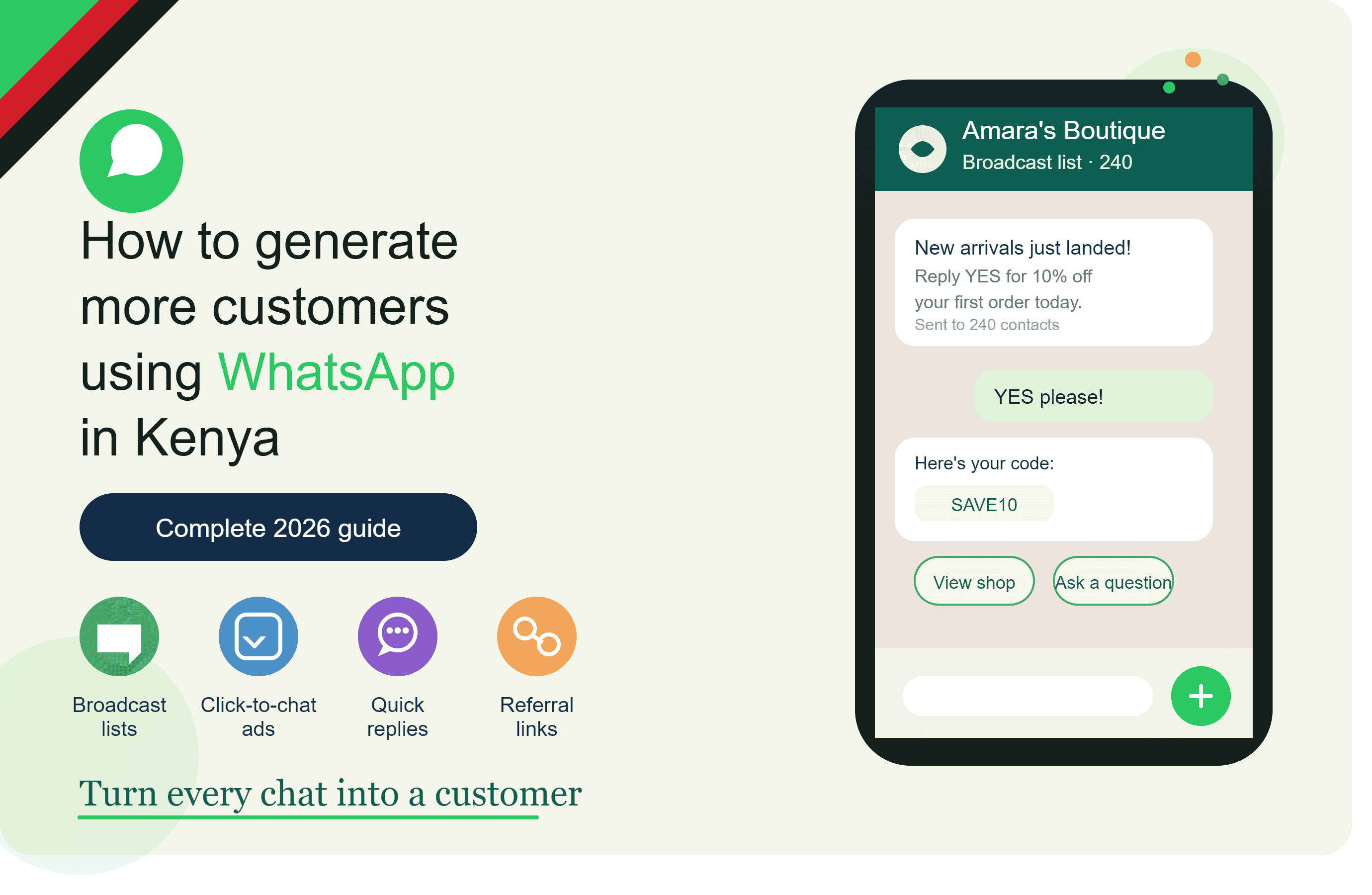
How to Generate More Customers Using WhatsApp in Kenya
Getting people to see your business is one thing.
Getting them to actually contact you is another.
And getting those enquiries to become paying customers is where many businesses struggle.
For many Kenyan businesses, WhatsApp can sit right in the middle of this process.
A customer may discover your business on Facebook, Instagram, TikTok, Google, your website or even a poster on the street.
Instead of asking them to fill out a long form, create an account or search for your phone number, you can give them one simple next step:
Start a WhatsApp conversation.
The journey can look like this:
Facebook → WhatsApp → Enquiry → Qualified Lead → Order → M-Pesa → Delivery
Or:
Google → WhatsApp → Question → Quote → Follow-up → Sale
This is the foundation of WhatsApp lead generation.
In this guide, we will look at how Kenyan businesses can use different channels to generate WhatsApp leads, qualify those leads, follow up properly and turn more conversations into business.
What Is a WhatsApp Lead?
A WhatsApp lead is a potential customer who has shown interest in your product or service and started a conversation with your business through WhatsApp.
For example:
Someone sees your Facebook advert for a three-bedroom house.
They click:
"Chat on WhatsApp."
They ask:
"How much is the house?"
That person is now a lead.
But not every lead is ready to buy.
Some are simply researching.
Others are comparing prices.
Some are ready to purchase today.
Your job is to understand where each person is in the buying process.
Why WhatsApp Works Well for Lead Generation in Kenya
WhatsApp is already part of everyday communication for many Kenyan consumers and businesses.
This gives businesses an opportunity to meet potential customers in a channel they already understand.
Instead of:
Advert → Website → Registration → Login → Contact Form → Wait
you can create a much shorter journey:
Advert → WhatsApp → Conversation
The conversation then gives you an opportunity to understand the customer's needs.
For example:
"Hi, what are you looking for?"
is often more useful than sending a customer to a generic homepage.
The WhatsApp Lead Generation Funnel
A simple WhatsApp lead funnel looks like this:
1. Attract
Get people to discover your business.
2. Click
Give them a reason to start a WhatsApp conversation.
3. Capture
Get the conversation into your WhatsApp inbox.
4. Qualify
Understand what the customer actually needs.
5. Recommend
Give the customer the right product or service.
6. Convert
Move the customer toward an order, booking, payment or quotation.
7. Follow up
Continue the conversation where appropriate.
8. Retain
Turn the customer into a repeat buyer.
The mistake many businesses make is stopping at step three.
They generate WhatsApp messages but have no system for managing the leads.
1. Generate Leads From Facebook to WhatsApp
Facebook can be an important source of leads for many Kenyan businesses.
Instead of running an advert that simply says:
"Buy our shoes."
you can create an advert with a clear action.
For example:
New Sneakers – KSh 3,500
Sizes 38–44 available.
Delivery available.
Chat with us on WhatsApp to check availability.
The customer sees the product.
They become interested.
They click WhatsApp.
Now you have a conversation instead of just an impression.
What Should Happen After a Facebook Lead Arrives?
Do not make the customer start from zero.
Your first response should help identify what they are interested in.
For example:
Hi 👋 Thanks for contacting ABC Shoes.
Which product are you interested in?
1️⃣ Men's sneakers
2️⃣ Ladies' sneakers
3️⃣ School shoes
4️⃣ Sports shoes
5️⃣ Talk to our team
This can help organise the conversation from the beginning.
2. Generate Leads From Instagram to WhatsApp
Instagram is particularly useful for businesses that depend heavily on visual products.
Examples include:
- Fashion
- Beauty
- Hair products
- Shoes
- Furniture
- Cars
- Electronics
- Food
- Events
- Photography
Your Instagram content should not only tell people what you sell.
It should tell them what to do next.
For example:
New arrivals are here 👗
Sizes 8–16 available.
Nairobi delivery available.
DM us or order through WhatsApp.
The objective is to turn attention into a conversation.
3. Generate Leads From TikTok to WhatsApp
TikTok can help businesses reach people who may never have searched for their product directly.
For example, a furniture business can post a short video showing:
- A new sofa
- The price
- Available colours
- The location
- Delivery options
Then finish with a clear call to action:
Want the price or available colours? Message us on WhatsApp.
The important thing is to give viewers a reason to contact you.
Don't simply say:
"WhatsApp us."
Instead:
"WhatsApp us for today's price and delivery options."
The second message tells the customer what they will get by starting the conversation.
4. Turn Your Website Visitors Into WhatsApp Leads
Having a website does not mean every customer wants to fill in a contact form.
Some visitors may have a simple question.
For example:
"Is this product available?"
A WhatsApp button can make it easier for them to ask.
Place WhatsApp calls-to-action on important pages such as:
- Homepage
- Product pages
- Pricing page
- Contact page
- Service pages
- Booking pages
- Property listings
For example:
Have a question about this product?
Chat with us on WhatsApp.
This can turn website traffic into direct conversations.
5. Generate WhatsApp Leads Using QR Codes
QR codes can connect offline marketing to online conversations.
Put your WhatsApp QR code on:
- Posters
- Business cards
- Shop windows
- Product packaging
- Receipts
- Banners
- Vehicles
- Brochures
- Event materials
- Restaurant menus
Imagine someone walking past your shop.
They see:
Order on WhatsApp
They scan the QR code.
WhatsApp opens.
The customer can immediately start a conversation.
This is particularly useful because it connects physical marketing with digital sales.
Example: Restaurant QR Code
A restaurant could place a QR code on its table:
Scan to Order on WhatsApp
The customer scans.
WhatsApp opens.
The customer receives:
Welcome to ABC Restaurant 🍽️
Reply:
- View menu
- Place order
- Delivery
- Talk to us
The QR code has now become a lead-generation tool.
6. Generate Leads From Google
Google is different from social media.
Someone searching Google is often looking for something specific.
For example:
"phone shop in Nairobi"
or:
"best catering company in Kitengela"
or:
"car hire Nairobi"
or:
"ladies clothes online Kenya"
These searches can bring people who already have a need.
Your Google presence should therefore make it easy for interested people to contact you.
Where appropriate, include a WhatsApp option in your digital presence.
Your website can also have a prominent WhatsApp button so that someone who finds you through Google can move directly into a conversation.
7. Use WhatsApp to Qualify Leads
Generating 1,000 WhatsApp messages is not necessarily better than generating 100 useful conversations.
The real question is:
How many of those conversations are potential customers?
This is why lead qualification matters.
Suppose you sell cars.
A new lead says:
"I'm interested in the Toyota."
Instead of immediately sending 20 paragraphs, ask a few useful questions.
For example:
Great. Are you looking for:
1️⃣ Cash purchase
2️⃣ Financing
3️⃣ Trade-in
What is your approximate budget?
Now you know more about the customer.
What Should You Ask a WhatsApp Lead?
The questions depend on your business.
For a fashion business:
- Which product?
- Size?
- Colour?
- Quantity?
- Delivery location?
For real estate:
- Property type?
- Preferred location?
- Budget?
- Buying or renting?
- When are you looking to move?
For a car business:
- Vehicle type?
- Budget?
- Cash or financing?
- New or used?
- Trade-in?
For a service business:
- Which service?
- When do you need it?
- Where are you located?
- What is your budget?
Do not ask ten questions at once.
Start with the most important ones.
8. Give Leads a Clear Next Step
A conversation should move somewhere.
For example:
Lead: How much is the phone?
Business: KSh 32,000.
Lead: Do you deliver to Nairobi?
Business: Yes. Delivery is available. Would you like us to reserve one for you?
That final question creates a next step.
Depending on your business, the next step could be:
- Place an order
- Book an appointment
- Request a quotation
- Schedule a viewing
- Make a payment
- Reserve a product
- Speak to a salesperson
Do not leave the customer wondering what to do next.
9. Follow Up With WhatsApp Leads
This is one of the biggest opportunities for businesses.
Not every customer buys immediately.
Someone may say:
"Let me think about it."
And disappear.
That does not always mean they are not interested.
They may:
- Be waiting for payday
- Need to consult someone
- Be comparing prices
- Be busy
- Have lost internet access
- Need more information
- Simply have forgotten
A polite follow-up can restart the conversation.
For example:
Hi Brian 👋
Just checking whether you still need the Samsung phone we discussed.
Let me know if you would like the current price or available payment options.
Keep it helpful.
Do not bombard the customer with messages.
10. Use Lead Follow-Up Automation
When you have many leads, remembering every conversation becomes difficult.
Imagine receiving 100 enquiries this week.
Some are:
Ready to buy
Some are:
Interested but undecided
Some are:
Waiting for stock
Some are:
Waiting for payday
Some are:
No longer interested
You need a way to organise them.
A WhatsApp commerce system can help you create different stages.
For example:
New Lead
↓
Contacted
↓
Qualified
↓
Interested
↓
Quotation Sent
↓
Payment Pending
↓
Customer
This is much better than relying on your memory.
11. Don't Treat Every Lead the Same
A person asking:
"How much?"
is different from someone saying:
"I want three pieces. How can I pay?"
The second customer is much further along the buying process.
Your communication should reflect that.
Early-stage lead
Give information.
Interested lead
Answer questions and recommend products.
Qualified lead
Give pricing, availability and next steps.
Ready-to-buy lead
Make ordering and payment easy.
This is why lead qualification matters.
12. Use Product Information to Speed Up Conversations
If customers constantly ask for the same product information, make it easy to provide.
For every product, prepare:
- Product name
- Price
- Photos
- Sizes
- Colours
- Features
- Availability
- Delivery options
- Payment options
A proper WhatsApp catalogue can reduce unnecessary back-and-forth.
Instead of typing:
"Let me send you the photos."
you can direct the customer to the product information.
13. Use WhatsApp for Lead Nurturing
Some leads need time.
A person may be interested in buying a laptop but not be ready today.
A real estate customer may need several weeks to decide.
A school parent may be comparing several schools.
A business looking for software may need approval before purchasing.
These people should not be treated as dead leads simply because they did not buy immediately.
With appropriate permission and relevant communication, you can continue nurturing the relationship.
For example:
Hi Jane. You previously asked about our office desks. We have just received a new range. Would you like me to send you the catalogue?
This is more useful than randomly sending promotional messages.
14. Build a Simple WhatsApp Lead Qualification Flow
You can create a basic automated conversation like this:
Welcome
Hi 👋 Welcome to ABC Electronics.
Question 1
What are you looking for?
1️⃣ Phones
2️⃣ Laptops
3️⃣ TVs
4️⃣ Accessories
Question 2
What is your approximate budget?
Question 3
Where should we deliver?
The answers help the business understand the customer.
A salesperson can then take over.
This is a good example of automation supporting sales rather than replacing salespeople.
15. Use WhatsApp Links With Pre-Filled Messages
You can create different WhatsApp entry points for different campaigns.
For example:
Facebook campaign
"Hi, I saw your Facebook advert and I'm interested in the sneakers."
Instagram campaign
"Hi, I saw your Instagram post. Please send me the available dresses."
Website
"Hi, I need help choosing a product."
This gives the business useful context immediately.
It can also help you understand which campaigns are generating conversations.
16. Track More Than WhatsApp Messages
Don't only count:
"We received 500 WhatsApp messages."
Track the complete journey.
For example:
StageNumberPeople reached20,000WhatsApp conversations500Qualified leads220Quotations/orders120Paid orders75Delivered orders70Repeat customers25
These numbers tell you much more about your sales process.
You can then ask:
- Which channel generates the most leads?
- Which products generate the most enquiries?
- How many leads become customers?
- How many customers return?
- Where are customers dropping off?
17. Connect Your Marketing Channels to One WhatsApp Sales Process
You may have customers coming from:
TikTok
Website
QR Codes
Referrals
Instead of managing each lead differently, bring them into a consistent sales process.
The journey becomes:
Traffic source
↓
↓
Lead qualification
↓
Product/service recommendation
↓
Order or quotation
↓
Payment
↓
Delivery/service
↓
Follow-up
This creates a much more organised sales operation.
Example: Kenyan Electronics Business
Imagine an electronics shop in Nairobi.
They run a TikTok video showing a smartphone.
A customer clicks WhatsApp.
Automated welcome
Hi 👋 Welcome to XYZ Electronics.
What are you looking for?
- Phones
- Laptops
- TVs
- Accessories
Customer selects:
Phones
The business asks:
What is your budget?
Customer:
Around KSh 30,000.
Now the salesperson can recommend phones within that range.
The customer chooses one.
The business creates an order.
Payment instructions are provided.
The payment is confirmed.
Delivery is arranged.
The customer receives a follow-up after delivery.
A social media video has therefore become a complete sales journey.
Example: Real Estate Business
A property company advertises a house on Facebook.
The advert says:
3-Bedroom House – Kitengela
Price: KSh X
Book a viewing through WhatsApp.
A potential buyer clicks WhatsApp.
The first questions could be:
Are you looking to:
1️⃣ Buy
2️⃣ Rent
Then:
What is your approximate budget?
Then:
Would you like to book a viewing?
The sales agent now has a more qualified lead rather than simply a phone number.
Example: Service Business
Suppose you run a digital marketing agency.
Someone finds you through Google and clicks WhatsApp.
Instead of:
"Hello, how can we help?"
you could ask:
Hi 👋 Thanks for contacting us.
Which service are you interested in?
1️⃣ Social media management
2️⃣ Website development
3️⃣ Digital advertising
4️⃣ WhatsApp automation
The customer selects an option.
You can then ask one or two additional questions.
The lead becomes easier to handle.
What Makes a Good WhatsApp Lead Generation Strategy?
A good strategy has five important parts.
1. A reason to contact you
Give customers something useful.
Examples:
- Price
- Catalogue
- Quote
- Consultation
- Booking
- Product availability
- Special offer
2. A clear call to action
Tell the customer what to do.
Chat on WhatsApp
is much clearer than:
Learn More
when your goal is to start a conversation.
3. A fast first response
The longer someone waits, the easier it is for them to move on.
4. Good qualification
Understand what the customer needs.
5. Follow-up
Don't abandon people simply because they did not buy immediately.
Common WhatsApp Lead Generation Mistakes
Sending people to WhatsApp without a clear purpose
Don't simply say:
"Contact us."
Tell them why.
"WhatsApp us for today's price."
is clearer.
Asking too many questions
Do not turn WhatsApp into a lengthy application form.
Ask only what you need.
Replying too slowly
A customer may already be talking to another seller.
Use automation for the first response where appropriate.
Sending huge blocks of text
WhatsApp is conversational.
Keep messages easy to read.
Treating every lead as a sale
Some people are researching.
Some are comparing.
Some are ready to buy.
Understand the difference.
Never following up
Many potential customers need time before making a decision.
A useful follow-up can bring them back.
Spamming leads
More messages do not automatically mean more sales.
Send relevant messages at appropriate times and follow applicable WhatsApp messaging requirements.
How MyWhatsApp Fits Into the Lead Generation Process
Generating a WhatsApp lead is only the beginning.
Once customers start coming in, you need to manage what happens next.
That can include:
- Capturing customer conversations
- Showing products
- Managing enquiries
- Organising customers
- Creating orders
- Sending payment instructions
- Confirming payments
- Following up
- Automating repetitive messages
- Managing multiple team members
- Tracking the customer journey
MyWhatsApp is designed around this WhatsApp-first business process.
The idea is straightforward:
Bring customers into WhatsApp, organise the conversation, help them find what they need, convert the enquiry into an order and continue the relationship after the sale.
A Simple 7-Day WhatsApp Lead Generation Plan
If you want to start immediately, here is a practical seven-day plan.
Day 1 — Set up WhatsApp Business
Complete your profile, business description and catalogue.
Day 2 — Create your WhatsApp link
Put it on your social media profiles and website.
Day 3 — Create your first campaign
Choose one product or service and give customers a reason to contact you.
Day 4 — Create your welcome message
Make sure new enquiries receive an immediate response.
Day 5 — Create your qualification questions
Choose two or three questions that help you understand your leads.
Day 6 — Create your follow-up process
Decide when and how you will follow up with people who have not purchased.
Day 7 — Measure your results
Record:
- Number of conversations
- Qualified leads
- Orders
- Payments
- Sales
- Follow-ups
- Repeat customers
Then improve the process.
The Bigger Opportunity
The biggest mistake is thinking of WhatsApp simply as another place where customers send messages.
It can become part of your entire sales system.
A customer may discover you on TikTok.
Another may find you through Google.
Someone else may scan a QR code from your shop.
Another customer may click an Instagram post.
They can all enter the same WhatsApp sales process.
Different traffic sources. One conversation channel. One organised customer journey.
That is what makes WhatsApp lead generation powerful for small and growing businesses.
Final Thoughts
You don't necessarily need thousands of followers to generate customers through WhatsApp.
What you need is a clear path from attention to conversation and from conversation to sale.
Start by choosing one traffic source.
It could be:
- TikTok
- Your website
- QR codes
Give people a clear reason to contact you.
Then build a simple process:
Attract → WhatsApp → Qualify → Recommend → Convert → Follow up → Retain
As your number of leads grows, introduce automation and proper customer and order management.
The objective is not to collect hundreds of WhatsApp chats that nobody follows up.
The objective is to build a system that helps your business turn genuine customer interest into real business.
For businesses ready to organise their WhatsApp sales process, explore MyWhatsApp.